The
Montreal Protocol, considered one of the most successful global
agreements in history, was an international agreement originally written
in 1987, but not put into action until 1989.
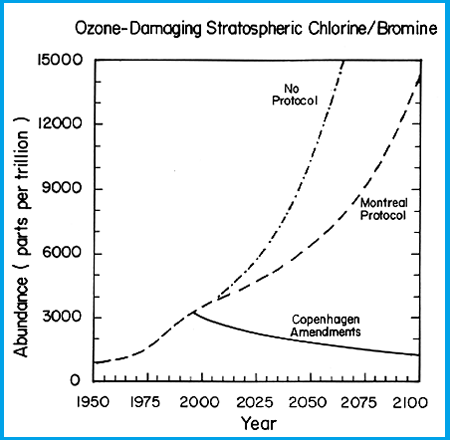
Its goal: reduce the production of CFCs by half in order to help restore the ozone layer.
The Montreal Protocol attempted to do so by slowly reducing the use of ozone depleting substances (ODS) a little each year, with differing rates for developed and developing nations.
CFCs were scheduled to be phased out by developed nations in 1995 and by developing nations in 2010.
Hydrochlorofluorocarbons
are scheduled to be phased out by 2020 for developed nations and 2040
for developing nations, with period reductions leading up to these
dates.