Global Warming Potential
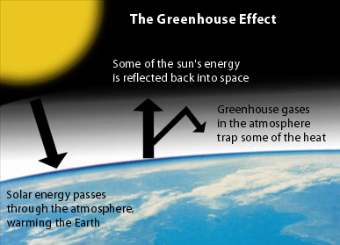
Each green house gas has a global warming potential. This is a measure of its ability to warm the atmosphere compared to carbon dioxide, which has a global warming potential of one.
|
Water Vapor
The most potent and abundant greenhouse gas is water vapor. However, as its concentrations in the atmosphere have not changed significantly in the past few decades, it is not viewed as being an anthropogenic greenhouse gas.
Rising temperatures will lead to an increased flux of water into the atmosphere.
Water vapor makes up approximately 60% of all greenhouse gases in the atmosphere.
|
Carbon Dioxide
Carbon dioxide is a colorless, odorless gas.
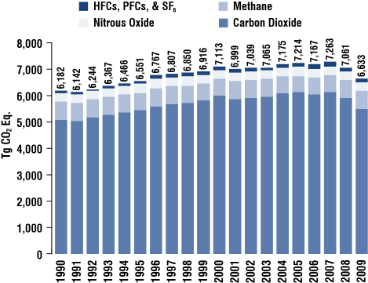
Although carbon dioxide is not the most potent anthropogenic greenhouse gas, it is the most abundant, making up about 83% of all anthropogenic U.S. greenhouse gas emissions.
The largest source of Carbon Dioxide emissions is the burning of oil, gas, and coal by industries, vehicles, and and power plants. Deforestation also adds to the levels of carbon dioxide in the atmosphere, as trees serve as carbon sinks.
|
Halocarbons
Halocarbons are compounds made up of carbon and at least one halogen. They are completely man-made with no natural sources.
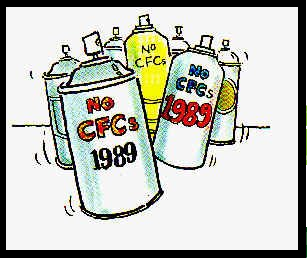
The most well known halocarbons are chlorofluorocarbons (CFCs), which are man-made products in which hydrogen atoms are replaced by either bromine, fluorine, or chlorine. CFCs have been used in air conditioners and refrigerators due to their heat absorbing abilities. They have also been used cleaning agents in the production of electronics.
However, the release rate of halocarbons has begun to slow down due to the Montreal Protocol.
|
|
|
Nitrous Oxide
Nitrous oxide is a colorless, sweet-smelling, nonflammable gas with a global warming potential of 296.
Nitrous Oxides have numerous sources, including feed lots, chemical manufacturing plants, auto emissions, and synthetic nitrogen fertilizers.
Approximately 5.5% of our greenhouse emissions comes from nitrous oxide.
|
Methane
Methane is colorless, odorless gas with a global warming potential of 23. It is the main component of natural gas.
Methane makes up about 10% of all U.S. greenhouse gas emissions, coming not only from the combustion of fossil fuels, but also from livestock, organic matter in land fills, and the planting of certain crops like rice. Around 50% of methane emissions come from human-related activities.
|
Ozone
Ozone is a toxic gas made up of three oxygen molecules. It formed in the troposphere by reactions between VOCs and nitrogen oxides and in the stratosphere by the interaction of oxygen and the sun's UV rays.
Because ozone is a secondary pollutant, no sources emit it directly into the atmosphere. However, its components are release through fossil fuel combustion by industries and vehicles.
Ozone makes up about 3% of all greenhouse gases. Since 1750 tropospheric ozone levels have risen 36%. |
|