El Niño.


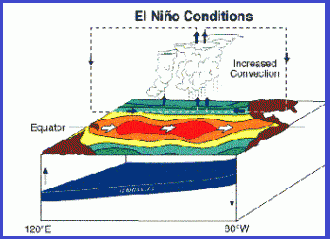
During El Niño, which occurs every three to seven years, atmospheric pressure switches from the eastern Pacific to the western Pacific, weakening trade winds.

Without these winds warm water flows toward the east and in turn suppresses coastal upwellings near the Americas. Without these nutrient-filled upwellings, aquatic life and fisheries in these areas suffer.

Because tropical storms are caused by warm, humid air above the oceans, the location of most tropical storms also shifts from the west to the east.

This also causes increased rainfall and flooding from Florida to California, along South America's Pacific coast, and in parts of Africa. Rainfall decreases in areas such as the Great Plains, Australia, and Indonesia.

This can lead to both floods and droughts, which can both have devastating effects on communities.

La Niña.

La Niña is the exact opposite of El Niño and therefore effects the environment in opposite ways. La Niña is often seen as a more intense version of normal conditions.

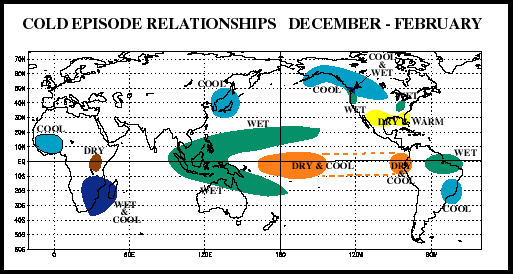
During La Niña pressure decreases in the western Pacific and increases in the eastern Pacific. Trade winds strengthen, resulting in colder than normal conditions in the eastern Pacific.

The amount of rainfall received by the typically dry regions in the eastern Pacific decreases due to colder, dryer air.

The amount received by typically wet regions in the western Pacific, particularly, Indonesia and Australia increases. Just last summer, La Niña was blamed for the drought in the Horn of Africa, which negatively affected crops and livestock and in turned resulted in famine.

Peruvian fishermen experience larger catches during La Niña than El Niño. La Niña also impacts fishing in the Straight of Juan de Fuca due to cooler temperatures preferred by the sockeye salmon.
This free website was made using Yola.

No HTML skills required. Build your website in minutes.

Go to www.yola.com and sign up today!

Make a free website with Yola